
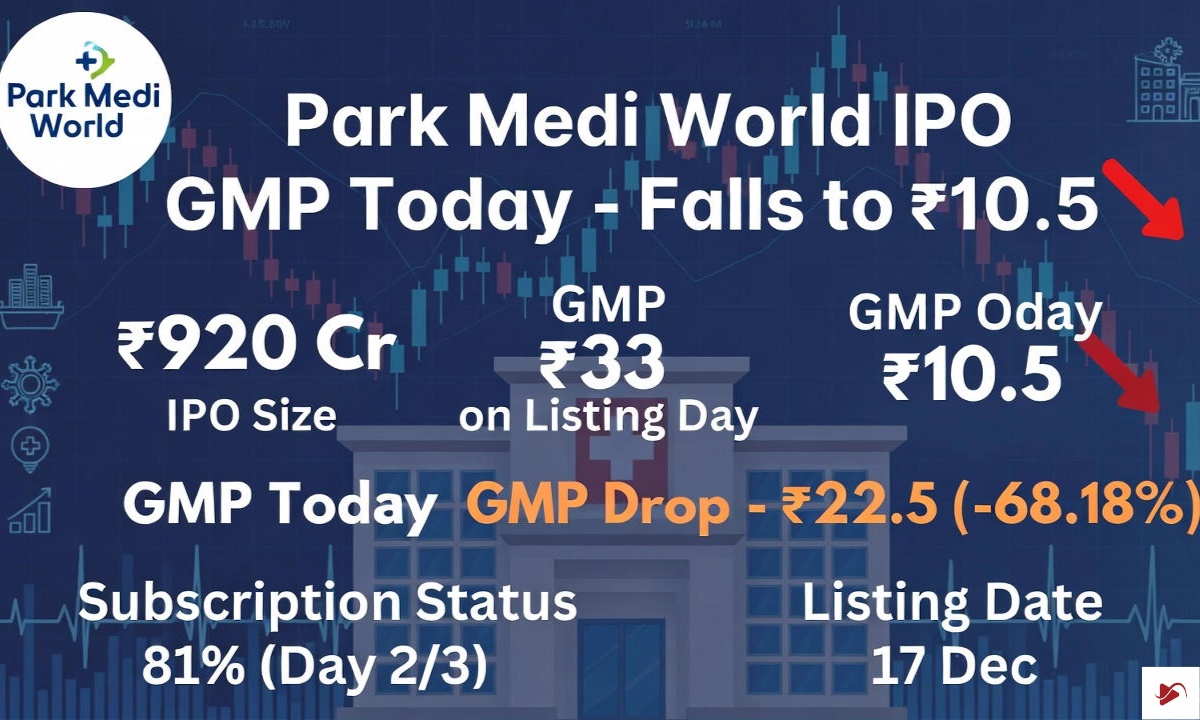
The initial public offering of Park Medi World Limited, North India’s second-largest private hospital chain, is experiencing a dramatic cooling of investor sentiment as grey market premium (GMP) has plunged from early highs of ₹33 to just ₹10.5 per share as of December 11, 2025—representing a mere 6.5% expected return over the upper price band of ₹162. The sharp decline in GMP, combined with tepid subscription numbers showing just 81% overall subscription by Day 2 despite anchor investments of ₹276 crore from 23 institutional investors, has triggered serious concerns about the issue’s pricing, valuation, and the company’s ability to attract retail and non-institutional investor participation.
The ₹920 crore IPO, which opened for public subscription on December 10, 2025, and closes on December 12, comprises a fresh issue of ₹770 crore and an offer for sale (OFS) of ₹150 crore from promoter Ajit Gupta. With shares set to list on BSE and NSE on December 17, 2025, the deteriorating grey market sentiment and weak subscription trends have raised red flags about potential listing day losses, forcing prospective investors to carefully weigh the company’s growth prospects against multiple risk factors including high contingent liabilities, heavy revenue concentration in Haryana, alarming 33.72% doctor attrition rate, and recent credit rating downgrades.
Grey Market Premium: Sharp Decline Signals Fading Enthusiasm
The Park Medi World IPO’s grey market journey tells a story of initial optimism giving way to growing skepticism as investors digested the company’s fundamentals and risk disclosures.
GMP Timeline and Trajectory:
Early December (Pre-Issue Opening):
- December 6: GMP reported at ₹33 (20.37% premium), translating to expected listing price of ₹195
- Market sentiment: Strongly positive, reflecting hope about healthcare sector growth and company’s expansion plans
Post-Issue Opening (December 10 onwards):
- December 8: GMP at ₹20.5 (12.65% premium), expected listing price ₹182.5
- December 10-11: GMP crashed to ₹10.5 (6.5% premium), expected listing price ₹172.5
- Market sentiment: Rapidly deteriorating as subscription numbers disappoint and risk factors gain attention
What the GMP Decline Indicates:
From ₹33 to ₹10.5 represents a 68% drop in grey market premium in less than a week—one of the steepest declines for a healthcare IPO in recent memory. This collapse suggests:
❌ Overpricing Concerns: Initial GMP of ₹33 likely reflected excessive optimism; reality check brings valuation questions to forefront
❌ Weak Demand Signal: Low subscription numbers validating grey market skepticism about investor appetite
❌ Risk Factor Awareness: As investors studied the Red Herring Prospectus (RHP) carefully, concerns about contingent liabilities, credit downgrades, and operational challenges dampened enthusiasm
❌ Peer Comparison Issues: Valuation appears stretched compared to listed hospital chains with stronger financials and operational metrics
❌ Market Conditions: Broader IPO market showing signs of fatigue after several disappointing listings
Current GMP Analysis (₹10.5 premium):
- Expected Listing Price: ₹172.5 (₹162 + ₹10.5)
- Expected Return: 6.5% over issue price
- Investment Required: ₹14,904 for 1 lot (92 shares)
- Expected Profit: ₹966 per lot if GMP holds at listing
While a 6.5% return might seem acceptable for a few days’ capital deployment, the rapid GMP decline raises serious questions about whether even this modest premium will hold on listing day or whether further downside awaits.
IPO Structure and Key Details
Issue Composition:
- Total Issue Size: ₹920 crore
- Fresh Issue: ₹770 crore (47.5 million shares) – proceeds go to company
- Offer for Sale: ₹150 crore (9.3 million shares) – proceeds go to promoter Ajit Gupta
Price Band and Lot Size:
- Price Range: ₹154 to ₹162 per share
- Lot Size: 92 shares
- Minimum Investment: ₹14,904 (at upper price band)
- For Retail Investors: 35% reservation; can apply for minimum 1 lot, maximum based on ₹2 lakh limit
Critical Dates:
- Issue Opens: December 10, 2025 (Tuesday)
- Issue Closes: December 12, 2025 (Thursday)
- Anchor Lock-In: December 9, 2025 (raised ₹276 crore from 23 investors)
- Basis of Allotment: December 15, 2025 (Monday)
- Refund Initiation: December 16, 2025 (Tuesday)
- Credit to Demat: December 16, 2025 (Tuesday)
- Listing Date: December 17, 2025 (Wednesday) on BSE and NSE
Use of Proceeds:
From the ₹770 crore fresh issue, Park Medi World plans to deploy funds as follows:
Debt Repayment (₹380 crore): Nearly 50% of fresh proceeds earmarked for repaying or prepaying outstanding borrowings—a red flag suggesting the company is overleveraged and using IPO primarily for deleveraging rather than pure growth
Hospital Development (₹60.5 crore): Development of new hospital by subsidiary Park Medicity (NCR) in the National Capital Region—expanding footprint in affluent Delhi-NCR market
Medical Equipment (₹27.46 crore): Purchase of modern medical equipment by the company and its subsidiaries—essential for maintaining competitive medical services
Unidentified Acquisitions: Remaining funds earmarked for future inorganic growth through acquisitions and general corporate purposes—vague allocation raising questions about management’s strategic clarity
Book Running Lead Managers:
- Nuvama Wealth Management Ltd.
- CLSA India Pvt. Ltd.
- DAM Capital Advisors Ltd.
- Intensive Fiscal Services Pvt. Ltd.
Registrar:
- KFin Technologies Limited: Responsible for allotment process and investor grievances
Subscription Status: Tepid Demand Raises Concerns
As of Day 2 (December 11, 2025), the Park Medi World IPO subscription numbers paint a concerning picture:
Overall Subscription: 0.81 times (81%)
This means the issue has received bids for only 81% of the shares on offer—indicating it may struggle to achieve full subscription even by the close on December 12 unless there’s a last-day rush.
Category-Wise Breakdown:
Qualified Institutional Buyers (QIBs): [Specific data not fully available, but typically this category leads; weak overall subscription suggests QIB participation is modest despite anchor book success]
Non-Institutional Investors (NIIs): [Data suggests moderate participation; wealthy individuals appear cautious about valuation and risks]
Retail Individual Investors (RIIs): [With 35% reservation and weak overall subscription, retail category likely seeing limited enthusiasm despite being the primary target for such healthcare offerings]
Comparative Context:
For perspective, recent successful healthcare IPOs typically achieve:
- 2-5x subscription by Day 2 (indicating strong demand)
- 10-20x oversubscription by final day for quality offerings
Park Medi World’s 0.81x subscription by Day 2 is alarmingly weak, suggesting:
- Investors are voting with their wallets by staying away
- Price band may be too aggressive for fundamentals offered
- Risk factors disclosed in RHP are deterring participation
- Competition from simultaneously open IPOs (Wakefit, Corona Remedies, Nephrocare) is splitting investor attention
Anchor Investor Round: Institutional Backing Provides Some Confidence
Despite weak public subscription, Park Medi World successfully raised ₹276 crore from 23 anchor investors on December 9, 2025, allocating 17 million shares at ₹162 per share (upper price band). The anchor round was approximately 30% of the total issue size—indicating institutional investors saw sufficient merit to invest, though at prices now being questioned by grey market and public investors.
Notable Anchor Investors Include:
Mutual Funds:
- Kotak Mahindra AMC
- Helios Mutual Fund
- ITI Mutual Fund
- Taurus Mutual Fund
Insurance Companies:
- SBI General Insurance Company
- Reliance General Insurance Company
Foreign Institutional Investors:
- Allianz Global Investors Fund
- Societe Generale
Other Institutional Investors:
- Abakkus Asset Manager
- Carnelian Bharat Amritkaal Fund
- Alchemie Ventures Fund
- Winro Commercial (India)
The quality and diversity of anchor investors provides some credibility to the issue. However, anchor investors have a one-year lock-in period, meaning they cannot sell immediately post-listing and may have different investment horizons and risk appetites compared to retail investors seeking listing gains.
About Park Medi World: Business Overview
Park Medi World Limited operates as the second-largest private hospital chain in North India, with a network of 14 hospitals across four states commanding approximately 3,000 beds as of September 30, 2024.
Geographic Footprint:
- Haryana: 8 hospitals (majority concentration—more on this risk later)
- Delhi NCR: 1 hospital (New Delhi)
- Punjab: 2 hospitals
- Rajasthan: 2 hospitals
- Madhya Pradesh: 1 hospital
Service Offerings:
Multi-Specialty Capabilities: Cardiology, oncology, neurology, orthopedics, gastroenterology, nephrology, pulmonology, urology, and more
Advanced Medical Technology: Modern diagnostic equipment, operation theaters, ICU facilities, imaging centers
Patient-Centric Approach: Focus on affordable healthcare delivery in Tier 2 and Tier 3 cities where healthcare infrastructure is limited
Operational Scale (as of September 2024):
Medical Staff:
- 891 doctors (concerning attrition rate of 33.72%—more on this critical risk later)
- 1,912 nurses
- 671 medical professionals
- 1,761 support staff
- Total Workforce: Approximately 5,235 employees
Patient Volume:
- H1 FY25 (April-Sept 2024): 40,368 inpatients
- FY24 (April 2023-March 2024): 73,284 inpatients
- FY23: 73,084 inpatients
- FY22: 62,106 inpatients
The patient volume data shows concerning stagnation between FY23 and FY24 (minimal growth from 73,084 to 73,284), raising questions about the company’s ability to scale admission numbers despite bed capacity expansion.
Financial Performance:
Profit After Tax (PAT):
- FY25 (year ended March 31, 2025): ₹213.22 crore
- FY24: ₹152.01 crore (40% YoY growth)
- FY23: [Earlier baseline, showing consistent growth trajectory]
Positive: PAT growing consistently over 3 years
Concern: High leverage (₹380 crore debt repayment planned) suggests profitability achieved while carrying significant debt burden
Earnings Per Share (EPS): As per peer comparison data, Park Medi World has the lowest EPS compared to peers like Apollo Hospitals and Fortis Healthcare—a significant red flag about profitability per share even after accounting for size differences.
Return Ratios:
The company boasts strong Return on Equity (ROE) and Return on Capital Employed (ROCE) metrics, suggesting efficient capital deployment and profitability generation—one of the few positive highlights in an otherwise concerning financial picture.
Five Critical Risk Factors Investors Must Know
The Red Herring Prospectus (RHP) and analyst reports highlight several material risks that explain the weak subscription and falling GMP:
Risk #1: Alarming Contingent Liabilities
Key Numbers:
- Contingent Liabilities (excluding corporate guarantees): 11.66% of net worth as of September 30, 2025
- Corporate Guarantees: 71.58% of net worth
- Combined Exposure: Over 83% of net worth tied up in contingent obligations
What This Means: Contingent liabilities represent potential future obligations that aren’t currently reflected on the balance sheet but could materialize under certain circumstances (lawsuits, regulatory actions, guarantees called). At 71.58% of net worth in corporate guarantees alone, Park Medi World has extended its financial neck significantly—if these guarantees are invoked, the company’s financial position could deteriorate rapidly.
Investor Concern: High contingent liabilities create uncertainty about true financial health and hidden obligations that may surface post-listing.
Risk #2: Credit Rating Downgrades
Timeline of Trouble:
December 2024: CARE Ratings downgraded the company’s long-term facilities from CARE A- (Stable) to CARE BBB+ (Stable)—a one-notch downgrade signaling deteriorating creditworthiness
January 2025: CARE Ratings removed the rating entirely—typically happens when facilities are repaid or restructured, but timing raises questions
May 2025: BRL (Brickwork Ratings) downgraded fund-based facilities to BWR B+ (Stable)—a significant drop indicating substantial credit risk
August 2025: BRL rating withdrawn after facilities were repaid
What This Pattern Suggests:
- Company faced credit stress serious enough to trigger multiple downgrades
- Facilities had to be repaid/refinanced, possibly at higher costs
- May explain why ₹380 crore (50% of fresh IPO proceeds) is earmarked for debt repayment
- Creditworthiness remains questionable despite recent repayments
Investor Concern: History of credit issues raises questions about financial management, leverage levels, and ability to service debt going forward.
Risk #3: Severe Doctor Attrition Rate
Critical Statistic: As of September 30, 2025, Park Medi World’s doctor attrition rate stands at 33.72%—meaning approximately one in three doctors leave the organization annually.
Industry Context:
- Healthcare industry average doctor attrition: 15-20%
- Leading hospital chains (Apollo, Fortis): 10-15%
- Park Medi World’s 33.72%: More than double industry average
Why This Matters:
- Patient Care Quality: High doctor turnover disrupts continuity of care and patient relationships
- Reputation Risk: Patients prefer hospitals with stable, experienced medical teams
- Recruitment Costs: Constant hiring and training cycles are expensive
- Operational Disruption: New doctors need time to understand protocols and systems
- Competitive Disadvantage: Senior, experienced doctors choosing competitors over Park Medi World
Root Causes (likely):
- Compensation not competitive with peers
- Work conditions or work-life balance issues
- Limited career advancement opportunities
- Management or organizational culture problems
- Geographic locations (Tier 2/3 cities) less attractive than metros
Investor Concern: If the company cannot retain medical talent, long-term growth and quality of care will suffer regardless of bed capacity expansion.
Risk #4: Heavy Revenue Concentration in Haryana
Geographic Revenue Breakdown:
- H1 FY26 (April-Sept 2025): Haryana contributed 83.91% of operating revenue
- H1 FY25: 76.92%
- FY25: 73.43%
- FY24: 74.62%
- FY23: 69.06%
Trend Analysis: Haryana’s revenue contribution increasing over time (from 69% to 84%), indicating growing concentration rather than diversification—opposite of healthy growth pattern.
Risk Implications:
- State-Specific Risks: Any adverse developments in Haryana (regulatory changes, competition, economic downturn, political issues) disproportionately impact Park Medi World
- Limited Geographic Diversification: Despite having hospitals in Delhi, Punjab, Rajasthan, and Madhya Pradesh, these collectively generate less than 20% of revenue
- Vulnerability to Local Competition: New hospital chains entering Haryana market could severely dent Park Medi World’s revenues
- Regulatory Concentration Risk: Haryana state health regulations, reimbursement policies, and government healthcare schemes heavily influence performance
Investor Concern: Lack of geographic revenue diversification makes the business model fragile and vulnerable to state-specific risks.
Risk #5: Acquisition-Led Expansion Strategy Risks
Acquisition Track Record:
- As of September 30, 2025: Acquired 8 hospitals in North India, adding 1,650 beds to network
- Future Plans: Company explicitly states intention to continue pursuing acquisition-led expansion
Inherent Risks in This Strategy:
Integration Challenges:
- Acquired hospitals may have different cultures, systems, protocols
- Staff resistance to new management and standardization efforts
- Patient loyalty to old management may not transfer seamlessly
- Technology systems integration can be expensive and time-consuming
Hidden Liabilities:
- Acquired hospitals may have undisclosed legal, regulatory, or financial issues
- Due diligence may miss problems that surface post-acquisition
- Contingent liabilities may increase further with each acquisition
Capital Deployment Risk:
- IPO proceeds allocated to “unidentified inorganic acquisitions”—vague, concerning language
- Company may overpay for acquisitions in competitive bidding
- Returns on acquisition investments may not justify costs
Execution Risk:
- Management bandwidth to integrate multiple acquisitions simultaneously
- Track record of past integrations not fully disclosed
- Industry expertise in M&A may be limited
Investor Concern: Aggressive acquisition strategy with vague fund allocation and integration risks could destroy shareholder value if executed poorly.
Peer Comparison and Valuation Analysis
Key Listed Healthcare Competitors:
Apollo Hospitals Enterprise Ltd.:
- Market leader with pan-India presence
- Higher EPS, better margins, stronger brand
- Trading at premium valuations justified by scale and track record
Fortis Healthcare Ltd.:
- Strong presence across major metros
- Better operational metrics than Park Medi World
- Comparable valuation multiples with stronger fundamentals
Max Healthcare Institute:
- Focuses on premium segment in NCR
- Superior operational efficiency and doctor retention
- Commands premium valuation
Park Medi World’s Valuation Positioning:
While exact P/E multiples aren’t disclosed, analyst reports suggest Park Medi World is being priced at valuations comparable to or slightly below peers on EV/EBITDA basis. However, this surface-level parity hides significant fundamental disparities:
Peer Advantages Over Park Medi World: ✅ Geographic diversification (not 84% dependent on one state)
✅ Better doctor retention (15-20% attrition vs. Park Medi World’s 33.72%)
✅ Stronger credit ratings with no recent downgrades
✅ Higher EPS indicating better profitability per share
✅ Lower contingent liabilities relative to net worth
✅ Established brand recognition and trust
✅ Presence in Tier 1 cities with affluent patient base
Park Medi World’s Advantages: ✅ Strong ROE and ROCE metrics
✅ Consistent PAT growth over 3 years
✅ Affordable healthcare positioning in underserved Tier 2/3 markets
✅ Lower competition in current geographic focus areas
Valuation Verdict: Despite trading at peer-comparable multiples, Park Medi World’s inferior operational metrics, higher risk profile, and geographic concentration suggest it should trade at a discount to established peers, not at parity. This explains the weak subscription and falling GMP.
Brokerage Recommendations: Mixed but Cautiously Optimistic
ICICI Direct: “Subscribe for Long Term”
Positive Factors Highlighted:
- Multi-super specialty hospital chain with advanced medical technology
- Patient-centric approach serving underserved North Indian markets
- Healthcare delivery sector projected to grow at 10-12% CAGR through FY29
- Company positioned to capture demand in growing sector
Investment Horizon: Long-term (3-5 years minimum)
Arihant Capital: Positive on Regional Leadership
Key Strengths Noted:
- Strong regional leadership in North India
- Cluster-based network strategy efficient for operations
- Proven ability to acquire and integrate hospitals
- Operational standardization supports scale-up
- Capital-efficient infrastructure model
Concern Acknowledged: Execution risk exists but considered manageable
Important Note on Brokerage Views:
Brokerage recommendations focus primarily on long-term growth potential and sector tailwinds rather than near-term listing gains. None of the brokerages are strongly recommending the issue for listing day profits—their “Subscribe” ratings assume investors will hold through volatility for 3-5 year sectoral growth story.
Given the weak GMP and subscription, investors seeking quick listing gains should be extremely cautious, as potential for listing day losses cannot be ruled out.
Should You Apply? Decision Framework
Consider Applying If:
✅ You have 3-5 year investment horizon and believe in India’s healthcare sector growth story
✅ You can tolerate significant near-term volatility and potential listing day losses
✅ You’re comfortable with high-risk, high-leverage business models in growth phase
✅ You view Park Medi World’s Tier 2/3 focus as differentiated positioning with lower competition
✅ You believe management can address doctor attrition, diversify revenue geographically, and execute acquisitions successfully
✅ You’re applying for long-term wealth creation, not listing gains
Avoid or Pass If:
❌ You’re seeking listing day profits—weak GMP and subscription suggest high probability of flat or negative listing
❌ You’re uncomfortable with heavy debt burden (₹380 crore repayment from IPO proceeds signals overleveraging)
❌ Credit rating downgrades concern you about financial stability
❌ 33.72% doctor attrition rate raises red flags about organizational culture and talent management
❌ 84% revenue from Haryana represents unacceptable concentration risk for your portfolio
❌ Contingent liabilities at 83% of net worth create too much uncertainty
❌ You prefer established brands with proven track records over emerging chains with execution risks
❌ You have short-term investment horizon and cannot afford capital being locked for years
The Middle Ground: Selective Application
Some investors may choose to apply for 1 lot only as:
- Lottery-based retail allocation means limited downside (₹14,904 maximum exposure)
- If issues get resolved and company executes well, long-term upside exists
- Diversification play in healthcare sector at reasonable entry point
However, avoid applying for multiple lots given the risk-reward profile and weak market sentiment.
How to Apply for Park Medi World IPO
Online Application (Recommended):
Via Net Banking:
- Log into your bank’s net banking portal
- Navigate to “Invest in IPO” or “ASBA” section
- Select “Park Medi World IPO”
- Enter number of lots, UPI ID, bid price (₹162 recommended)
- Submit application—funds will be blocked, not debited
Via UPI (Easiest):
- Log into your broker’s trading app (Zerodha, Groww, Angel One, etc.)
- Go to IPO section
- Select Park Medi World, enter details
- Approve UPI mandate when prompt appears
- Funds blocked until allotment
Offline Application:
Visit your bank branch with:
- Filled ASBA form
- PAN card copy
- Demat account details
- Cheque for blocking amount
Important Application Tips:
Bid Price: Always bid at upper price band (₹162) to maximize allotment chances
Cutoff Option: Select “Cut-off” to ensure your application remains valid even if issue price is different
Multiple Accounts: Applying from multiple demat accounts with same PAN is not allowed and will result in rejection
Application Deadline: December 12, 2025, by market close (likely 5 PM)
Allotment Process and Timeline
Basis of Allotment: December 15, 2025 (Monday)
How to Check Allotment Status:
Method 1 – Registrar Website (KFin Technologies):
- Visit: https://kosmic.kfintech.com/ipostatus/
- Select “Park Medi World Limited”
- Enter PAN/Application Number/Demat Account
- View allotment status
Method 2 – BSE Website:
- Visit: https://www.bseindia.com/investors/appli_check.aspx
- Select “Equity” and “Park Medi World”
- Enter application details
Method 3 – NSE Website:
- Visit NSE IPO section
- Enter PAN and select Park Medi World
- Check status
Refunds/Credits: December 16, 2025
- Successful allottees: Shares credited to demat accounts
- Unsuccessful applicants: Unblocked funds released
Listing Date: December 17, 2025 (Wednesday)
- Trading begins at 10:00 AM on BSE and NSE
- Listing price determined by demand-supply dynamics
Final Verdict: High Risk, Uncertain Reward
Park Medi World IPO presents a high-risk proposition with uncertain near-term rewards despite operating in the promising healthcare sector. The combination of weak subscription (81% by Day 2), collapsing GMP (from ₹33 to ₹10.5), multiple red flags in the RHP (credit downgrades, 33.72% doctor attrition, 84% revenue from Haryana, 83% of net worth in contingent liabilities), and aggressive valuation relative to operational metrics suggests this IPO is best suited for investors with:
- High risk tolerance
- Long-term investment horizon (3-5 years minimum)
- Belief in India’s healthcare sector growth story
- Ability to withstand near-term volatility and potential losses
- Diversified portfolio where Park Medi World represents small allocation
For Conservative Investors: AVOID. Too many risk factors, weak market reception, potential for listing losses.
For Moderate Risk Investors: CAUTIOUS APPROACH. Apply for 1 lot maximum if healthcare sector exposure desired, but be prepared to hold long-term regardless of listing performance.
For Aggressive/Long-Term Investors: SELECTIVE CONSIDERATION. Despite near-term concerns, if you believe management can execute on growth plans, resolve operational issues, and capitalize on sector tailwinds, consider small allocation with 3-5 year holding period.
Our Rating: ⭐⭐☆☆☆ (2/5)
Risk Level: HIGH
Recommended Action: AVOID or APPLY 1 LOT FOR LONG TERM ONLY
Disclaimer: This analysis is for informational purposes only and should not be construed as investment advice. IPO investments carry market risks including loss of principal. The author does not trade in grey markets and does not recommend grey market participation. Conduct thorough due diligence, read the Red Herring Prospectus carefully, and consult SEBI-registered financial advisors before making investment decisions. Past performance of IPOs and GMP predictions do not guarantee future results.