
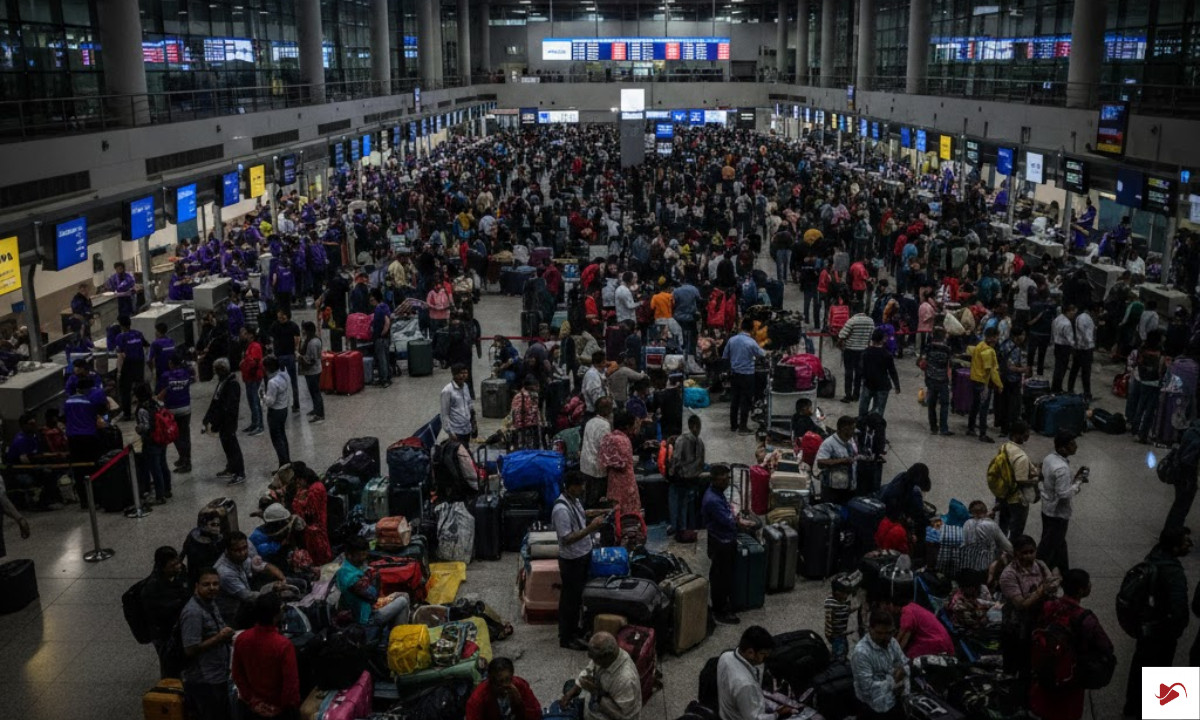
In what has emerged as the most severe operational crisis in its 19-year history, IndiGo Airlines, India’s largest carrier, has plunged the nation’s aviation sector into unprecedented chaos with more than 1,300 flight cancellations over the past five days. The massive disruption, which reached its peak on Friday, December 5, 2025, has left thousands of passengers stranded across major airports nationwide, triggering widespread protests, soaring ticket prices on alternative airlines, and urgent government intervention.
The airline, which commands a dominant 60% share of India’s domestic aviation market and operates over 2,000 daily flights carrying more than 300 million passengers annually, has been forced to cancel well over 1,000 flights on December 5 alone—representing more than half of its normal daily operations. The cascading operational breakdown has affected every major airport in the country, from Delhi and Mumbai to Bengaluru, Chennai, Hyderabad, Kolkata, and beyond, creating scenes of chaos and frustration as passengers faced long queues, delayed information, and limited alternatives.
Delhi IndiGo Airlines Airport Brings Operations to Complete Halt
Contents
- 1 Delhi IndiGo Airlines Airport Brings Operations to Complete Halt
- 2 Nationwide Airport Chaos and Passenger Ordeals
- 3 IndiGo’s On-Time Performance Collapses to Historic Low
- 4 Root Causes: New Pilot Duty Regulations and Crew Shortages
- 5 Government Intervention and DGCA Response
- 6 Ripple Effects: Soaring Fares and Railway Relief Measures
- 7 Recovery Timeline and Passenger Relief Measures
- 8 Looking Ahead: Questions of Accountability and Future Preparedness
The crisis reached its dramatic crescendo on Friday when Delhi’s Indira Gandhi International Airport issued an extraordinary advisory announcing that all IndiGo domestic flights departing from the capital would be cancelled until midnight. The unprecedented move effectively grounded the airline’s entire Delhi operation for the day, with airport officials confirming that approximately 220-235 flights, including both departures and arrivals, were cancelled at India’s busiest aviation hub.
“IndiGo domestic flights departing from Delhi Airport on December 5, 2025, are cancelled till 23:59 hours. Operations for all other carriers remain as scheduled,” the Delhi Airport authority stated in its passenger advisory issued at 11:10 AM. The airport’s dedicated ground teams worked diligently with all partners to mitigate the disruption and ensure passenger comfort, though the sheer scale of the crisis overwhelmed their efforts.
By late Friday evening, Delhi Airport issued a fresh update bringing cautious optimism: “We are glad to update that IndiGo flight operations are now steadily resuming and getting back to normalcy following the brief disruptions. Please check the status of your booking and flight before leaving home.” However, the damage had already been done, with thousands of passengers having endured hours of uncertainty and frustration throughout the day.
Nationwide Airport Chaos and Passenger Ordeals
The disruption extended far beyond Delhi, creating havoc at airports across the country. At Bengaluru’s Kempegowda International Airport, more than 100 flights were cancelled on Friday alone, with 42 cancellations reported on December 3. Chennai Airport witnessed similar chaos, with officials requesting IndiGo to hold all departure gates for passengers booked until 6:00 PM, as most base flight passengers remained stuck in check-in and boarding areas.
Hyderabad’s Rajiv Gandhi International Airport saw over 90 flight cancellations, with terminals packed with stranded travellers waiting desperately for updates amid widespread delays. The situation at Srinagar International Airport proved equally dire, with 10 out of 18 scheduled IndiGo flights cancelled on Friday, while the remaining flights faced significant delays. Similar scenes unfolded at Jammu Airport, where 11 IndiGo flights were scrapped, prompting angry protests from hundreds of stranded passengers.
Passenger testimonies painted a harrowing picture of the crisis. One frustrated traveller narrated a prolonged ordeal: “I am fed up with IndiGo’s services. Yesterday, I had a direct flight from Mumbai to Kolkata, but it was cancelled and rescheduled via Chennai. After reaching Chennai, that flight was cancelled as well. They then revised my journey from Chennai to Port Blair and onwards to Kolkata. Now I have received another message saying that the Port Blair to Kolkata flight has also been cancelled.”
At Jammu Airport, Swati, a pilgrim returning to Lucknow after visiting Mata Vaishno Devi, expressed her distress: “We have been waiting here for two hours for information about the status of our flight, but no satisfactory reply has come from the airline officials. Where would I go? They said it has been cancelled.” Another stranded passenger, Arti Razdan, scheduled to travel to Bengaluru, recounted her frustration: “I had come to Jammu to attend a marriage function. I was originally booked for December 2 but my flight was cancelled on both December 2 and 3. It is Friday, and my ticket got cancelled again.”
IndiGo’s On-Time Performance Collapses to Historic Low
The operational crisis has devastated IndiGo’s reputation for punctuality and reliability, which the airline had meticulously built over nearly two decades. On Friday, the carrier’s On-Time Performance (OTP) collapsed to a catastrophic 8.5%—the lowest ever recorded in its operational history and a stark departure from the airline’s celebrated “IndiGo Standard Time” practice of closing gates early to maintain schedules.
Aviation data reveals the staggering scope of the breakdown: IndiGo cancelled 1,230 flights in November 2025 alone, followed by more than 300 cancellations in just the first four days of December. The crisis intensified dramatically on December 4, when approximately 95 flights were cancelled at Delhi Airport since morning, before escalating to the peak of over 1,000 cancellations on Friday, December 5.
Root Causes: New Pilot Duty Regulations and Crew Shortages
The crisis stems from a perfect storm of operational challenges, with the primary culprit being IndiGo’s failure to adequately prepare for new Flight Duty Time Limitations (FDTL) rules implemented by the Directorate General of Civil Aviation (DGCA). The revised fatigue-management regulations, rolled out in phases with full enforcement from November 1, 2025, were designed to reduce pilot fatigue and ensure safety in India’s rapidly growing air travel industry.
The new rules significantly tightened restrictions on pilot flying times and placed stricter limitations on nighttime operations. Most critically, the mandatory rest period per week for pilots was increased by 12 hours to 48 hours total. Additionally, the regulations imposed maximum flight duty periods for pilots conducting night flying and specified limits on nighttime landings.
IndiGo CEO Pieter Elbers openly admitted the airline’s failure in a video message issued on Friday: “I, on behalf of all of us at IndiGo, would like to extend our sincerest apologies for the major inconvenience this has caused to many of our customers on account of delays or cancellations.” He acknowledged that December 5 was the most severely impacted day, with cancellations crossing 1,000. Elbers revealed that IndiGo had misjudged crew requirements, leading to the cascading operational collapse despite having nearly two years to prepare for the new regulations.
Aviation analysts attribute IndiGo’s troubles to aggressive network expansion without commensurate crew readiness. “The airline expanded faster than its ability to train and deploy pilots and cabin crew. With such a vast network, even minor disruptions trigger a cascading operational collapse,” an aviation expert explained. The airline expanded its Winter 2025 schedule ambitiously while simultaneously facing the constraint of new duty-time regulations and a severe shortage of trained cabin crew.
Government Intervention and DGCA Response
The unprecedented scale of the crisis forced urgent government intervention at the highest levels. Civil Aviation Minister K. Rammohan Naidu convened an emergency meeting with IndiGo’s senior management on Friday, chaired by top aviation officials, to discuss restoring flight operations and reducing passenger inconvenience. The government also ordered a high-level, four-member committee inquiry to investigate the airline’s lapses in preparation and planning.
Minister Naidu stated on Friday evening that normal flight operations were expected to “begin to stabilise and return to normal by tomorrow (Saturday, December 6). We anticipate that complete restoration of services will be achieved in the next three days.” He announced various operational measures, including keeping new flight duty norms temporarily in abeyance, to help address the disruptions.
In a significant relief measure, the DGCA granted IndiGo temporary exemptions from specific FDTL rules on Friday. The airline received a reprieve from regulations restricting nighttime landings and maximum flight duty periods for pilots doing some night flying, valid until February 10, 2026. However, the government did not exempt IndiGo from the stricter new rule mandating 48 hours of mandatory rest per week for pilots.
The DGCA also issued strict directives demanding that IndiGo submit a detailed recruitment roadmap for pilots and cabin crew within 15 days, along with fortnightly progress reports. The regulator cited risks to consumer confidence and air travel reliability, while also criticizing the airline for inadequate passenger-handling manpower revealed during inspections at major airports, including Delhi Terminal 1.
The Federation of Cabin Crew Representatives (FCCR) issued a scathing letter alleging that IndiGo failed to prepare adequately for the new norms despite having nearly two years, and instead expanded its Winter 2025 schedule recklessly. The association suggested that the resulting disruptions—surfacing just 35 days after Phase II rollout—may have been engineered to pressure the government. The letter urged the regulator to withdraw all dispensations, investigate IndiGo’s actions, and take punitive steps against the airline’s management.
Ripple Effects: Soaring Fares and Railway Relief Measures
The IndiGo crisis triggered severe ripple effects across India’s aviation sector, with ticket prices on rival airlines skyrocketing by 50-70% on several key routes as stranded passengers scrambled for alternatives. The Delhi-Mumbai corridor, among the world’s busiest air routes, was hit especially hard.
Last-minute non-stop Delhi-Mumbai flights for December 6, 2025, were listed between Rs 38,376 and Rs 48,972 on major online travel platforms, while one-stop options ranged from Rs 49,585 to Rs 65,460. Some platforms displayed even steeper climbs, with fares starting at Rs 33,636 and peaking at a staggering Rs 83,890. Under normal circumstances, a last-minute seat on this route would cost approximately Rs 20,000—barely one-third of the inflated prices.
Air India, Vistara, and AirAsia India all witnessed massive surges in demand and corresponding fare increases, with passengers accusing rival airlines of “cashing in on the crisis.” Social media platforms were flooded with complaints under hashtags such as #IndiGoCrisis and #FlightChaos, with travellers demanding compensation, clearer communication, and regulatory intervention.
In response to the aviation chaos, Northern Railways announced emergency relief measures to accommodate stranded passengers. Officials confirmed that an additional 3rd AC coach with 72 seats has been attached to the Jammu-New Delhi Rajdhani Express for the next seven days beginning December 5. Senior Divisional Commercial Manager Uchit Singhal said the move aimed to ease the distress of passengers caught in the chaos at Jammu airport. “Stranded passengers can avail of this facility by booking seats in the additional coach,” he stated. Passengers welcomed the Railway’s initiative as rare relief amid the widespread uncertainty.
Recovery Timeline and Passenger Relief Measures
IndiGo has outlined an ambitious recovery timeline, though the path to normalcy remains uncertain. CEO Pieter Elbers stated on Friday: “Given the size, scale and complexity of our operations, it will take some time to return to a full normal situation, which we anticipate between 10 and 15 December.” He indicated that progressive improvement should begin from Saturday, December 6, with “well over” 1,000 flights cancelled on Friday representing the peak of the crisis as the airline works to “reboot all systems and schedules.”
The airline informed the DGCA that it would curtail flight schedules from December 8 to stabilise scheduling and maintenance. However, IndiGo told regulators that full operational recovery is not expected until February 10, 2026, once newly recruited pilots and cabin crew complete training and certification. This timeline suggests the disruptions, though diminishing in severity, could continue intermittently for the next two months.
To mitigate passenger inconvenience, IndiGo has announced several relief measures:
Free Cancellations and Changes: The airline is offering waivers on all cancellations and booking changes for travel between December 5 and December 15, 2025.
Refund Process: Passengers can opt for a full refund or rebook themselves on the next available IndiGo flight at no additional charge by submitting their PNR, email ID, and passenger details on the airline’s refund page. Refunds for online payments are typically credited within 5-7 business days, while cash bookings require passengers to visit an IndiGo airport ticket counter.
Passenger Advisory: IndiGo has urged passengers not to come to airports for cancelled flights to help manage crowds and avoid additional delays. The airline is sending SMS and email notifications to registered contact details regarding any changes in flight status.
Looking Ahead: Questions of Accountability and Future Preparedness
As India’s aviation sector grapples with the worst operational crisis in recent memory, serious questions are being raised about IndiGo’s management, planning capabilities, and regulatory oversight. The airline’s near-monopoly position—controlling approximately 60% of India’s domestic market—means that any significant disruption to its operations has catastrophic consequences for the entire aviation ecosystem and millions of travellers.
Aviation experts are calling for greater accountability and more robust contingency planning across the industry. The crisis has exposed vulnerabilities in how airlines manage crew scheduling, adapt to regulatory changes, and maintain operational resilience during periods of rapid expansion. There are growing calls for the DGCA to implement stricter oversight mechanisms and ensure airlines maintain adequate buffer capacity in crew resources to prevent similar meltdowns in the future.
For IndiGo, the path forward requires not just operational stabilisation but also rebuilding passenger trust and confidence. The airline, once celebrated for its punctuality and reliability, now faces the daunting task of demonstrating that it has learned from this crisis and implemented systemic changes to prevent recurrence. The coming weeks will be crucial in determining whether IndiGo can successfully navigate this unprecedented challenge and restore its reputation as India’s most dependable airline.
As passengers across India continue to monitor their flight statuses anxiously and brace for potential further disruptions, the aviation industry waits to see whether IndiGo’s recovery timeline holds true and whether December 10-15 will indeed mark the return to normalcy—or whether this crisis will extend further into the critical holiday travel season.